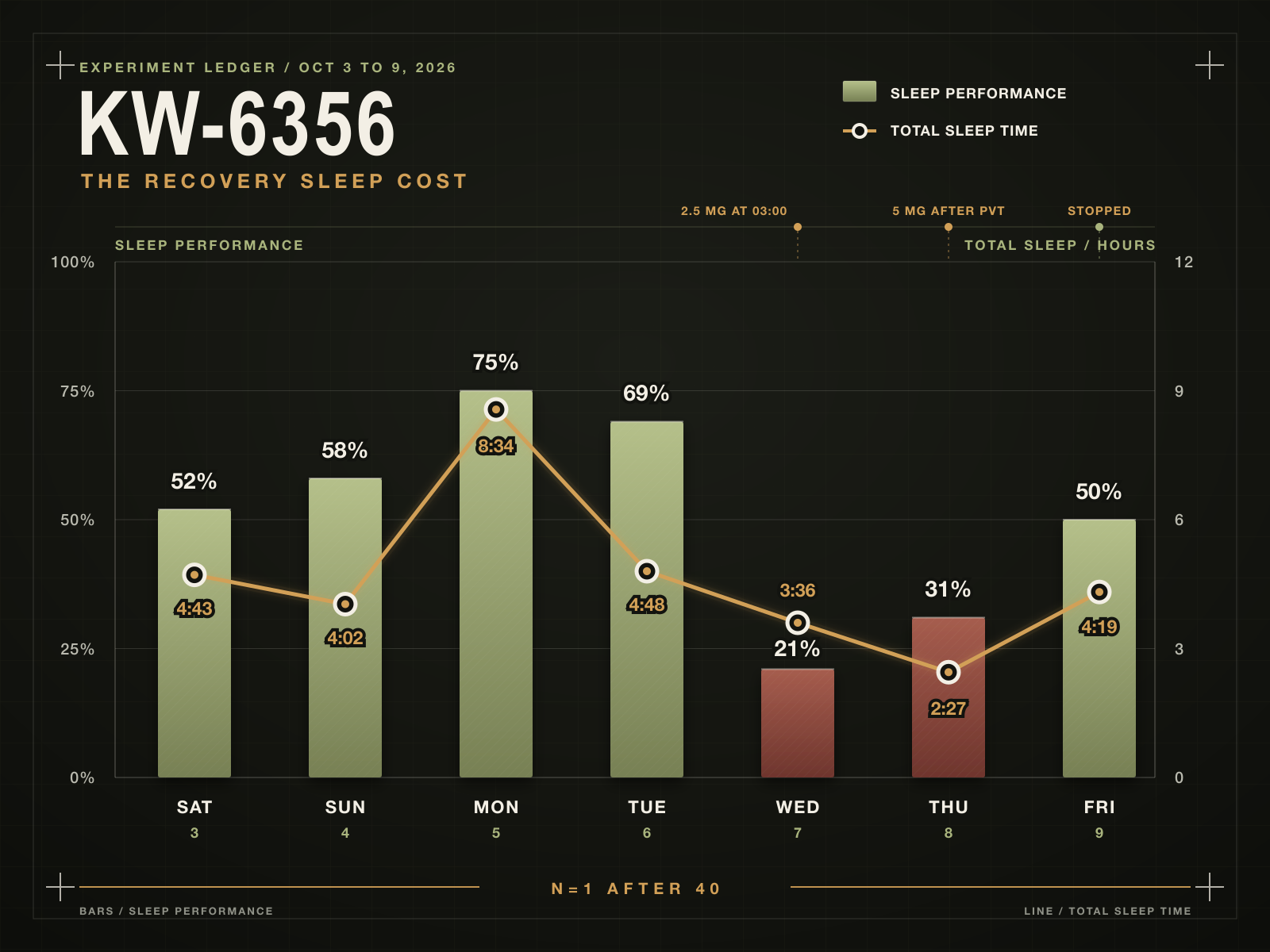
What KW-6356 is
KW-6356, also called sipagladenant, is an investigational selective adenosine A2A receptor antagonist and inverse agonist developed by Kyowa Kirin for Parkinson's disease. Laboratory work found high A2A affinity, slow dissociation, and insurmountable antagonism. Those receptor findings do not establish cognitive enhancement in healthy people.
Phase 1 established pharmacokinetics, not focus
Healthy men received single doses from 1 to 60 mg and repeated doses of 6 or 24 mg once daily for up to 14 days. The controlled studies reported tolerability at those studied exposures and the long half-life range used in this experiment's carryover planning. They did not test focus, reaction time, or performance during sleep loss.
The Parkinson's results were mixed
In an early trial of untreated Parkinson's disease, motor scores improved numerically by 5.37 points with 3 mg and 4.76 points with 6 mg, versus 3.14 points with placebo. Neither active dose significantly separated from placebo. A later 502-person trial as an add-on to levodopa did meet its primary motor endpoint, with improvements of 7.8 points at 3 mg and 7.0 points at 6 mg, versus 5.2 points with placebo. The numerical pattern does not prove that 3 mg is superior to 6 mg.
Why development stopped
Kyowa Kirin discontinued development in July 2022 after reviewing the global regulatory landscape, development hurdles, and expected time to market. The company did not describe the decision as a safety failure.
Why sleep pressure was the test condition
Adenosine signaling contributes to accumulating sleep pressure. Mouse knockout work supports a necessary role for A2A receptors in caffeine-induced arousal, and human caffeine research links ADORA2A variation with vigilance and recovery sleep during prolonged wakefulness. These findings made an A2A-based wakefulness hypothesis reasonable. They did not show that KW-6356 preserves focus or performs better than caffeine.
The direct human evidence gap
No controlled human study identified here tested KW-6356 for focus, vigilance, or decision quality during sleep deprivation. A small crossover study in 20 rested healthy men tested the related drug istradefylline, not KW-6356. One social-information measure changed; the other cognitive and cardiovascular measures did not significantly change. This experiment therefore began with an open question, not an expected positive result.
Material documentation
The supplied one-page qNMR report lists KW-6356, an assumed molecular weight of 397.4, and 99.9% purity. Its displayed arithmetic recalculates to 99.909%. The page does not include the full spectrum, an orthogonal identity test, a finished-solution concentration assay, or visible linkage between the tested powder and this vial. For that reason, this page treats the recorded amounts as label-equivalent exposures based on the vial concentration.
Sources
- Ohno et al., Molecular Pharmacology, 2023: receptor pharmacology, slow dissociation, and insurmountable antagonism.
- Tayama et al., Clinical Pharmacology in Drug Development, 2023: Phase 1 safety and pharmacokinetics in healthy men.
- Maeda et al., Parkinsonism & Related Disorders, 2023: early untreated Parkinson's trial.
- NCT03703570: levodopa-adjunct Phase 2b study record.
- Kyowa Kirin, October 21, 2020: Phase 2b primary-endpoint announcement.
- Kyowa Kirin, July 15, 2022: development discontinuation notice.
- Hook et al., European Neuropsychopharmacology, 2023: istradefylline cognition study in rested healthy men.
- Huang et al., Nature Neuroscience, 2005: A2A receptors and caffeine-induced arousal in mice.
- Bodenmann et al., Sleep, 2012: ADORA2A variation, caffeine, vigilance, and recovery sleep after prolonged wakefulness.
- Van Dongen et al., Sleep, 2003: cumulative objective impairment and subjective sleepiness during sleep restriction.